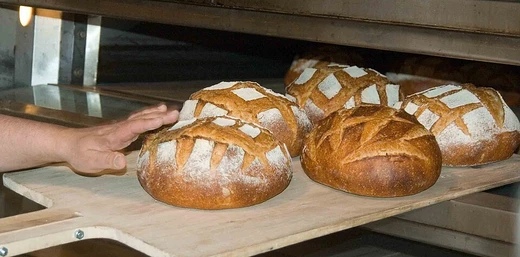
Bread
One of the oldest prepared foods, essential across cultures.
Bread is a baked food product made from water, flour, and often yeast. It is a staple food across the world, particularly in Europe and the Middle East, and has been an important part of many cultures' diets throughout recorded history. It is one of the oldest human-made foods, having significance since the dawn of agriculture, and plays an essential role in both religious rituals and secular culture.
- type
- Food product
- earliest_evidence
- 14,500-year-old Natufian site in Jordan
- earliest_leavened_bread
- 6000 BC in southern Mesopotamia
- primary_grain
- Common or bread wheat
- key_proteins
- Glutenin and gliadin
- modern_process
- Chorleywood bread process (1961)
Lore & Background
Bread is one of the oldest prepared foods, with evidence from 30,000 years ago in Europe and Australia showing starch residue on rocks used for pounding plants. The oldest evidence of bread-making comes from a 14,500-year-old Natufian site in Jordan's northeastern desert. Around 10,000 BC, with the dawn of the Neolithic age and the spread of agriculture, grains became the mainstay of making bread. An early leavened bread was baked as early as 6000 BC in southern Mesopotamia, cradle of the Sumerian civilization, who may have passed on the knowledge to the Egyptians around 3000 BC. The Egyptians refined the process and started adding yeast to the flour.
Reader's Guide
Bread is the staple food of the Middle East, Central Asia, North Africa, Europe, and European-derived cultures, in contrast to parts of South and East Asia where rice or noodles are staple. It is usually made from wheat-flour dough cultured with yeast, allowed to rise, and baked. Common or bread wheat is the most common grain due to its high gluten levels, which give dough sponginess and elasticity. Bread is also made from other wheat species and non-wheat cereals, often in combination with wheat flour due to lower gluten content. Gluten-free breads use flours from almonds, rice, sorghum, corn, legumes, or tubers, with additives like xanthan gum to compensate for lack of gluten. Bread can be served at many temperatures, eaten with the hands, spread with butter, dipped into liquids, topped with spreads, or used for sandwiches. It is also used as an ingredient in breadcrumbs, croutons, and stuffing. Acrylamide, a neurotoxic and carcinogenic compound, has been found in bread crusts heated above 120 °C. A study found that industrially produced bread with short rising times has high FODMAP carbohydrates causing flatulence, while longer rising times (four hours) break down most FODMAPs and improve tolerance.
Did You Know?
- The oldest evidence of bread-making comes from a 14,500-year-old Natufian site in Jordan.
- The Chorleywood bread process, developed in 1961, uses intense mechanical working to reduce fermentation time.
- Acrylamide, found in bread crusts heated above 120 °C, is neurotoxic and carcinogenic.
- A long rising time of four hours can break down 90% of FODMAP carbohydrates that cause discomfort.
More in Baking 1-24
Elsewhere in the Baking universe
Spotted an error? Know more?
This is a living reference — every entry is fact-audited, and reader corrections feed straight into our audit queue. Suggest an edit · See this site's audit record