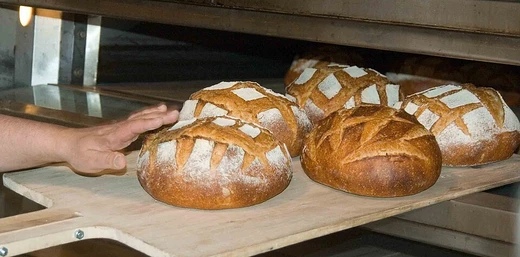
Pita
Yeast-leavened round flatbread common in the Mediterranean and Middle East.

Pita, also known as Greek bread, Arabic bread, Syrian bread, Lebanese bread, and pocket bread, is a family of yeast-leavened round flatbreads baked from wheat flour. It is common in the Mediterranean, Middle East, and neighboring areas, and includes the widely known version with an interior pocket.
- type
- Flatbread
- origin
- Near East (prehistoric flatbreads)
- also_known_as
- Greek bread, Arabic bread, Syrian bread, Lebanese bread, pocket bread
- main_ingredient
- Wheat flour
Lore & Background
Pita has roots in the prehistoric flatbreads of the Near East. However, there is no record of the steam-puffed, two-layer 'pocket pita' in ancient texts or medieval Arab cookbooks; food historians believe it was a later development. Hypotheses trace it to Ancient Greek πίττα or πίσσα ('pitch/resin'), or πικτή ('fermented pastry'), or to Classical Hebrew פת (patt, 'a morsel of bread'). The word has been borrowed into Turkish as pide and appears in Balkan languages. In Arabic, it is called خبز (khubz, 'bread') or الخبز العربي ('Arab bread'). In Egypt, it is called eish baladi or simply eish.
Reader's Guide
Pita is significant as a staple bread across the Mediterranean, Middle East, and neighboring areas, with a history stretching back to prehistoric flatbreads. Its most distinctive feature is the interior pocket formed when the dough is baked at high temperatures, causing steam to puff it up. This pocket makes pita versatile for scooping sauces or dips like hummus, or wrapping kebabs, gyros, and falafel. The bread is traditionally served fresh from a wood-fired oven and is best eaten the same day. Modern commercial production uses advanced automatic lines, baking thousands of pitas per hour at much higher temperatures. The term 'pita' can refer to various flatbreads in different cultures; in Greece, 'pita' often means 'pastry' and is used for cakes and pies, while the flatbread wrap is used for souvlaki. In Turkish cuisine, 'pide' can refer to a flatbread, a pizza-like dish, or Ramazan pidesi. In the Balkans, local styles are known as lepinja or somun, while 'pita' itself means 'pie'. The bread's adaptability and long history make it a foundational element in many cuisines.
Did You Know?
- In Greek, 'pita' (πίτα) by default refers to the thicker, pocketless Greek pita, while the thinner khubz-style pita is called 'aravikí pita' (Arabic pastry).
- In Turkish cuisine, the word 'pide' may refer to three different styles of bread: a flatbread, a pizza-like dish called içli pide, and Ramazan pidesi.
More in Baking 1-24
Elsewhere in the Baking universe
Spotted an error? Know more?
This is a living reference — every entry is fact-audited, and reader corrections feed straight into our audit queue. Suggest an edit · See this site's audit record