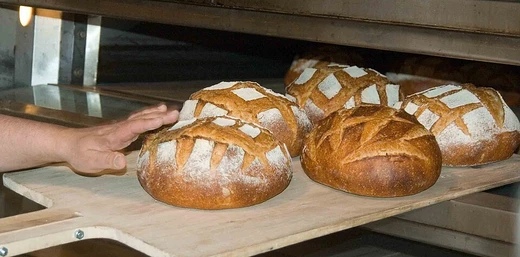
Baking powder
A chemical leavener that releases gas to lighten baked goods.
Baking powder is a dry chemical leavening agent composed of a carbonate or bicarbonate and a weak acid, with a desiccant such as cornstarch to prevent premature reaction. It releases carbon dioxide gas through an acid–base reaction when moistened and heated, increasing the volume and lightening the texture of baked goods. Its introduction revolutionized baking by minimizing time and labor, leading to the creation of quick breads and new types of cakes, cookies, and biscuits.
- first_american_patent
- Eben Norton Horsford, 1856, for baking powder using monocalcium phosphate
Lore & Background
The first commercially sold baking powder was Borwick's Baking Powder, launched in England in 1842 by George Borwick, who developed his formula as a yeast substitute for home baking. The following year, in 1843, pharmacist Alfred Bird developed his own single-acting baking powder, which releases all carbon dioxide as soon as it is dampened. In 1856, Eben Norton Horsford, the Rumford Professor at Harvard University, received an American patent for baking powder using monocalcium phosphate. The first double-acting baking powder was developed later, by the Calumet Baking Powder Company in the late 1880s or early 1890s.
Reader's Guide
Baking powder's significance lies in its ability to leaven baked goods quickly and reliably without the fermentation flavors or time required by yeast. It works through an acid–base reaction between a bicarbonate base (commonly sodium bicarbonate) and one or more acid salts, releasing carbon dioxide gas. The inclusion of a desiccant like cornstarch prevents premature reaction and improves shelf life. Double-acting baking powders, which contain both fast-acting and slow-acting acids, provide a second rise in the oven, making the timing between mixing and baking less critical. This type is now the most widely available. The introduction of baking powder was revolutionary in minimizing the time and labor required to make breadstuffs, leading to the creation of new types of cakes, cookies, biscuits, and other baked goods. It is used instead of yeast where fermentation flavors would be undesirable or where the batter lacks the elastic structure to hold gas bubbles for more than a few minutes.
Did You Know?
- The first commercially sold baking powder was Borwick's Baking Powder, launched in England in 1842.
- The first double-acting baking powder was developed by the Calumet Baking Powder Company in the late 1880s or early 1890s.
- Double-acting baking powders release some carbon dioxide when dampened and more when heated.
- Cornstarch is commonly used as a desiccant in baking powder to absorb moisture and prolong shelf life.
Elsewhere in the Baking universe
Spotted an error? Know more?
This is a living reference — every entry is fact-audited, and reader corrections feed straight into our audit queue. Suggest an edit · See this site's audit record