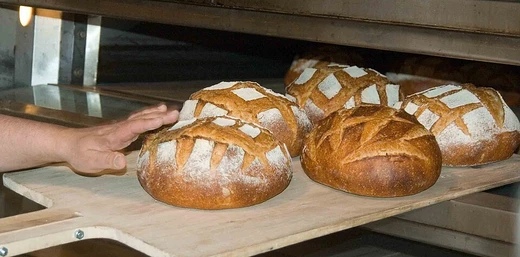
Baguette
Long, thin French bread defined by law and cultural tradition.
The baguette is a long, thin type of bread commonly made from basic lean dough, defined by French law in both its dough and physical dimensions. It is distinguishable by its length and crisp crust. In 2022, the artisanal know-how and culture of baguette bread was inscribed on the UNESCO Intangible Cultural Heritage Lists.
- field
- Bread
- nationality
- French
- known_for
- Long, thin loaf with crisp crust; symbol of French culture
- typical_length
- About 65 cm (26 in), up to 1 m (39 in)
- typical_diameter
- About 5 to 6 cm (2–2+1⁄2 in)
- typical_weight
- Around 250 g (8+3⁄4 oz)
Lore & Background
Much of the history of the baguette is speculation, but some facts can be established. Long, stick-like breads in France became more popular during the 18th century. French bakers started using 'gruau,' a highly refined Hungarian high-milled flour, in the early 19th century. Viennese steam oven baking was introduced to Paris in 1839 by August Zang, and compact yeast was introduced in 1867. The word 'baguette' first appears to define a particular type of bread in a regulation of the department of the Seine in August 1920: 'The baguette, having a minimum weight of 80 g and a maximum length of 40 cm, may not be sold for a price higher than 0.35 francs apiece.' No one of these events constitutes 'the invention of the baguette,' but together they define the modern baguette.
Several origin myths exist. Some say Napoleon created the baguette to allow soldiers to carry bread more easily. Other stories credit baguettes as an invention to stop French metro workers from carrying knives to cut their bread. Another account states that in October 1920, a law prevented bakers from working before 4 am, making it impossible to make traditional round loaves in time for breakfast; the slender shape of the baguette solved the problem because it could be prepared and baked more quickly. The law in question appears to be one from March 1919, though some say it took effect in October 1920.
Reader's Guide
The baguette is closely connected to France, though it is made worldwide. Outside France, it is often considered a symbol of French culture, but the association of France with long loaves long predates it. Long, wide loaves had been made since the time of King Louis XIV, long thin ones since the mid-18th century, and by the 19th century, some were far longer than today's baguette. In 1993, the French Parliament passed Le Décret Pain, which placed strict guidelines on what pain traditionnel français is allowed to be made of, banning pre-made dough from being used for traditional French baguettes. Since 1994, the city of Paris awards the Grand prix de la baguette de tradition française de la ville de Paris for the best baguette in the city. The baguette's legacy includes its inscription on the UNESCO Intangible Cultural Heritage Lists in 2022, recognizing the artisanal know-how and culture of its production. The average consumption of bread in France fell from 600 grams/day in the early 1900s to 170 grams/day in 1986, yet the baguette remains a staple of French cuisine and daily life.
Did You Know?
- The word 'baguette' means 'wand,' 'baton,' or 'stick' in French.
- In April 1944, a competition called Le Grand Prix de la Baguette began in France to determine who made the best baguettes.
- A baguette has a diameter of about 5 to 6 cm and a usual length of about 65 cm, but can be up to 1 m long.
- In November 2018, documentation surrounding the craftsmanship and culture of making baguette bread was added to the French Ministry of Culture's National Inventory of Intangible Cultural Heritage.
More in Baking 1-24
Elsewhere in the Baking universe
Spotted an error? Know more?
This is a living reference — every entry is fact-audited, and reader corrections feed straight into our audit queue. Suggest an edit · See this site's audit record